The Marketing Hive Framework
Marketing built around your website and the capacity of the person running it.
The Marketing Hive Framework is a six-part framework for attracting perfect-fit clients, developed by Nina Mills of Butter Digital for allied health practitioners, private practices and established service businesses. It puts your website at the centre of your marketing, so your visibility grows from the strength of what you’ve built, not how fast you can feed the ‘content machine’.
Most service providers I know are in the business of serving their clients.
And marketing is a whole other job that demands its own time, energy, capacity and skill set.
You either do it yourself, you have the resources to pay someone, or…you ignore it (Which can work for a while. But if your business relies on a steady stream of clients, at some point you need a way for those people to find you).
How did this framework come about?
March 10 2022.
That was the last time I posted on Instagram over on Feel Good Eating’s account.
I was burnt out and disillusioned by changes to the platform and the toxic energy showing up every time I opened the app.
So, in more of a ‘screw this’ than an intentional decision, I broke the biggest rule in the social media playbook and
Just. Stopped. Posting.
Rather than tanking, my business stayed steady, and I even ran a successful campaign for my online program. All without the pressure of showing up every day on social media.
Why?
Because I’d invested my time and energy in:
- Building a website that not only looked great, but helped guide my visitors to all my best bits and made it easy for them to reach out to work together;
- Writing my copy so that potential clients could get to know me and get a feel for what it would be like to work with me while also feeling like they had arrived in a space where someone else truly understood what they were going through;
- Making sure my website was set up for Google to read easily, plus creating SEO-optimised content so that when the clients I most love helping were searching for support for the things they’re struggling with, I had a darned good chance of my website showing up at the top of their search results.
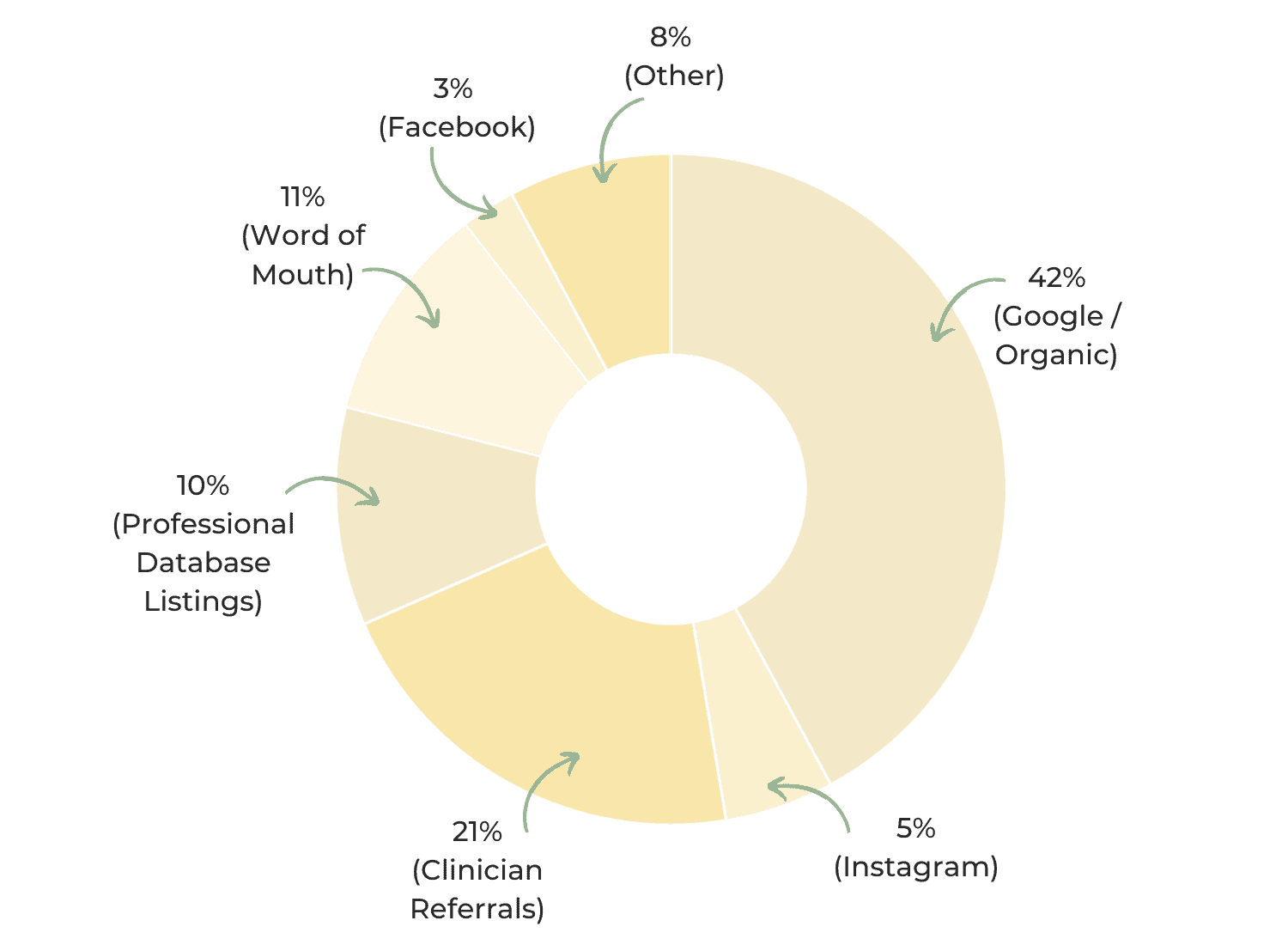
Between March and August that year, 42% of my new client enquiries came from a Google search. Instagram brought 5%, Facebook 3%. And I hadn’t written a blog post since January.
The TL:DR: when my own capacity for active marketing disappeared, the work I’d put into my online presence kept working.
Then search changed
The search landscape that made those results possible for Feel Good Eating in 2022 looks very different now.
“Build it, and they will come” was always a bit of a stretch, but a well-built, well-optimised website and some patience are only part of the picture.
Over the last two or three years, AI has changed how people find things.
Getting seen at all now takes a site structured so both traditional and modern search can read it, plus expertise substantial enough to stand out from the generic content AI search is serving up by default.
There are now more pieces involved in getting found. But our human capacity hasn’t magically expanded to match.
The six parts of the Marketing Hive Framework
1. Your Website (the hive)
Your source of truth.
Your website is the owned asset at the centre of your online presence.
It’s where the most complete version of your business lives: who you help, what you do, what you believe, what it’s like to work with you, and how someone takes the next step. It carries your brand, your positioning and your conversion pathways.
Every other part of this framework either feeds your website or flows out from it. That’s what makes it the hive.
2. Structure (the honeycomb)
Make your website findable, usable & understandable.
Structure is the technical foundation of your website that helps people, traditional search engines, and AI search understand and navigate your website.
It includes site architecture, technical SEO, schema, internal linking, UX and performance.
Strong structural integrity (like the honeycomb of a beehive) helps you get found and gives your perfect-fit people a clear pathway through your website once they arrive.
3. Your Expertise (the honey)
Give them something worth finding.
Honey is the precious, valuable substance inside the Hive, just like your expertise is.
Your copy, experience, resources, and point of view build your online authority, which gives humans and search tools substantive information to understand and associate with you, as well as helping people decide whether to trust you.
As AI makes generic information abundant (hi AI-slop), your experience, perspective, and unique approaches to your work become increasingly valuable, and better position you to become known for something beyond the basic information available everywhere else.
4. Your distribution (the worker bees)
Getting your expertise in front of the right people.
Your distribution system is what pushes your expertise out beyond your website through search, social media, email, referrals, collaborations, directories, links, mentions and other relevant platforms.
The aim isn’t to create a new content machine for every channel or platform out there. It’s to use the expertise you already have and put it to work in more places, strengthening your visibility across the web.
5. Attention + Insight (the nectar)
Attract your perfect-fit people and learn from them.
When all of the other parts of the Marketing Hive Framework are in place, you will be in a better position to attract your perfect-fit people to your website and convert that attention into enquiries and clients.
But in this part of the Framework you’re also gaining insights from what comes back through the system: search behaviour, analytics, rankings, what people share in their enquiries, what questions they’re asking, the language they use, etc.
You feed those insights back into your Website, Structure, Expertise and Distribution, so the next thing you do is informed by what you’re learning rather than creating content for content’s sake.
6. Your Capacity (the tending)
Accounting for the human in the business.
This part of the Framework recognises that service-based businesses are powered by humans.
And human resources are finite.
For many of the people I work with (particularly in the health and wellness space), a significant portion of their resources are spent caring for, supporting, or providing a service to other people.
Traditional marketing advice fails to account for that. It favours high-energy, high-output, always-on tactics that demand a constant supply of attention and content (and therefore time, money, energy and skills), which sit uncomfortably alongside the values of the person expected to carry them out.
Capacity influences what you build, what you create, how you distribute it, what you invest in and what kind of growth you can support.
Because the system needs to work for the humans you’re trying to reach and the humans responsible for sustaining it.
Building an online presence that builds on itself
Each part of the Framework strengthens, informs or influences the others and is what turns individual marketing activities into a connected system.
Your Website gives your online presence an owned source of truth.
Its Structure makes that source understandable to humans and technology.
Expertise builds a growing body of valuable, distinctive information associated with you and your business.
Distribution takes that expertise further, rather than asking you to continually create from scratch.
Attention + Insight brings perfect-fit people back and gives you information that makes the system stronger.
And Capacity shapes how you build and maintain all of it.
Over time, your efforts accumulate. For example:
- The article you wrote six months ago can still rank, be cited, become an email, inspire a social post or answer a prospective client’s question.
- The website page you improved can convert people arriving from multiple channels.
- The expertise-driven content you distribute creates more signals around what your business is known for.
- The insight you gather gives you data to improve future marketing strategies.
And that gives you flexibility.
There may be periods when you have the capacity to publish, distribute and actively grow your visibility.
And there may be periods when client work is heavy, life is life-ing, money is tighter, or you just don’t have as much to give to marketing.
The aim is to have built enough of a presence underneath your business that turning the marketing dial down doesn’t mean turning your visibility off.